


AI Compliance
AI-Powered Integration with Built-In Compliance Controls
AI Laws Are Here.
Is Your Data Foundation Ready?
Regulators worldwide are moving AI compliance down into the data and integration layer. For CIOs, CTOs and General Counsel, the core question is no longer 'Do we have an AI policy?' but 'Can we prove, in minutes, where our AI-related data came from, how it was transformed and who touched it?' Boards and regulators expect traceable AI data flows within the next 12-18 months.
Compliance
What the Laws Actually Require

EU AI Act (Europe)
The Law: A risk-based framework requiring strict data governance, automatic logging, and traceability for "high-risk" AI (e.g., HR, credit, healthcare). Most high-risk rules take effect in August 2026.
The Penalty: Fines up to €35 million or 7% of global annual turnover for prohibited practices, and up to €15 million or 3% of global turnover for data governance and logging failures.
The Penalty: Fines up to €35 million or 7% of global annual turnover for prohibited practices, and up to €15 million or 3% of global turnover for data governance and logging failures.

AI Basic Act (South Korea)
The Law: Effective Jan 2026, it requires documented risk-management plans, data summaries, and "meaningful explanations" of AI decisions for high-impact AI across 11 critical sectors.
The Penalty: Fines of up to KRW 30 million (~USD $20,400) for failing to comply with corrective orders or appoint a domestic representative, alongside intense, public regulatory inspections.
The Penalty: Fines of up to KRW 30 million (~USD $20,400) for failing to comply with corrective orders or appoint a domestic representative, alongside intense, public regulatory inspections.

Emerging U.S. AI Regulation
The Law: Imposes strict AI safety oversight, risk assessments, and mandatory content labeling/watermarking for AI-generated outputs.
The Penalty: A massive 20x increase in fines, reaching up to RMB 10 million (~USD $1.4 million) for corporate entities, plus personal fines up to RMB 1 million (~USD $140,000) for directly responsible executives, and the potential revocation of business licenses.
The Penalty: A massive 20x increase in fines, reaching up to RMB 10 million (~USD $1.4 million) for corporate entities, plus personal fines up to RMB 1 million (~USD $140,000) for directly responsible executives, and the potential revocation of business licenses.

China: Sector-Specific Rules
The Law: Heavily inspired by the EU AI Act, it mandates the right to an algorithmic explanation, anti-bias protections, and strict governance for high-risk systems.
The Penalty: Severe financial penalties reaching up to BRL 50 million (~USD $8–9 million) or 2% of total annual revenue in Brazil, plus mandatory suspension of business activities for high-risk violations.
The Penalty: Severe financial penalties reaching up to BRL 50 million (~USD $8–9 million) or 2% of total annual revenue in Brazil, plus mandatory suspension of business activities for high-risk violations.

Brazil: AI Bill No. 2,338/2023 Advancing
The Law: Heavily inspired by the EU AI Act, it mandates the right to an algorithmic explanation, anti-bias protections, and strict governance for high-risk systems.
The Penalty: Severe financial penalties reaching up to BRL 50 million (~USD $8–9 million) or 2% of total annual revenue in Brazil, plus mandatory suspension of business activities for high-risk violations.
The Penalty: Severe financial penalties reaching up to BRL 50 million (~USD $8–9 million) or 2% of total annual revenue in Brazil, plus mandatory suspension of business activities for high-risk violations.

GDPR - General Data Protection Regulation (EU/EEA)
The Law: States are actively enforcing anti-discrimination and transparency rules for AI used in consequential decisions like hiring and credit, requiring impact assessments and data tracing.
The Penalty: In Colorado, fines of $20,000 per violation, plus the threat of Attorney General injunctions shutting down your AI. In Illinois, full civil liability exposing companies to direct lawsuits and actual damages from affected individuals.
The Penalty: In Colorado, fines of $20,000 per violation, plus the threat of Attorney General injunctions shutting down your AI. In Illinois, full civil liability exposing companies to direct lawsuits and actual damages from affected individuals.
Accountability
Who in Your Organisation Is Accountable
Global AI regulations in the EU, South Korea, the US, China and Brazil all share one feature: extraterritorial reach. What matters is where your users are, not where your headquarters sits. For CIOs, CTOs and legal leaders, that means concrete accountability for how AI-related data moves through your systems, not just high-level policies.
Governance
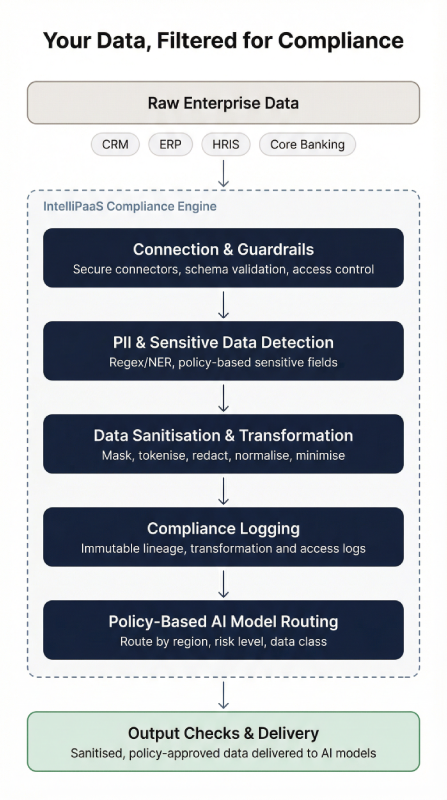
Your Data, Filtered for Compliance
Every AI request passes through a multi-layered compliance engine before it reaches any model. Raw enterprise data enters at the top; only sanitised, policy-approved prompts exit at the bottom. Each layer validates, detects, transforms and logs, so you can prove compliance at every step.
Obligations
How You’re Expected to Comply
Regulators are no longer satisfied with static policies. Compliance now requires deep infrastructural changes to prove exactly how data behaves before it reaches your models.

End-to-End Data Lineage
The EU AI Act (for high-risk AI systems) and South Korea's AI Basic Act require robust data governance and risk-management, which in practice means traceable data lineage and evidence of how AI-related data was prepared and used. This means answering exactly which columns from which specific systems fed a decision and how they were transformed along the way.

Automatic Logging and Audit-Ready Records
Authorities require the ability to reconstruct a system's lifecycle. You must maintain central, queryable logs that connect source data, transformations, model versions, inferences and resulting downstream actions.
.png)
Cross-System Visibility
Regulators expect holistic governance. If a credit model relies on a CRM, core banking systems and fraud tools, the entire data flow across the integration layer must be governed, not just the isolated AI model.

Anti-Discrimination Audits and Content Provenance
US state laws (Colorado, Illinois) and even China's AI regulations demand content output tracking, bias testing records and provenance metadata embedded directly at the data integration layer.
Exposure
The Challenge: Your Integration Layer Is the Blind Spot
Most organisations now have AI governance tools (OneTrust, Holistic AI, CompliAI) to create inventories, risk scores and policies. But those tools sit above the data. The hard questions from regulators and boards sit beneath that layer:
"Where did this applicant’s data actually come from?"
"Which fields were used in the credit decision? From which systems?"
"Can you show us logs that link source → transformation → model → decision over the last 12 months?"
.png)
If your integration and data pipelines are opaque, AI governance dashboards alone will not get you through an audit. You cannot confidently answer an auditor when they ask how specific data fields were transformed along the way. IntelliPaaS is not another governance dashboard that sits above your data; it is the governed data pipeline beneath those dashboards, where compliance is enforced at the point of transformation.
Capabilities
What IntelliPaaS Can Do
IntelliPaaS is an enterprise integration platform built for AI-driven workflows, with governance, lineage and logging embedded at the data-flow level. We do not replace your AI governance tools; we provide the verifiable data plumbing beneath them. We sit alongside your existing tech stack (AWS, Azure, MuleSoft, Boomi) to ensure your data is compliant before it ever hits the AI model.
Impact
How This Affects Your Business Today
This lack of data visibility is no longer just a technical debt issue—it is an immediate legal and financial risk. If you do not address the opacity in your integration pipelines, your business faces:
Failed Conformity Assessments
Under the EU AI Act, if you cannot prove your training and input data is governed, traceable and logged, your "high-risk" system cannot legally be placed on the market.
Massive Financial Penalties
The EU AI Act levies fines up to €15 million or 3% of global turnover for data governance failures. Brazil's AI Bill No. 2,338/2023 proposes fines up to BRL 50 million or 2% of total revenue.
Inability to Defend Against Bias Claims
Under US state laws, if an applicant alleges AI discrimination, a static policy will not protect you. You need hard system logs proving what data the model actually saw.
Wasted Audit Prep Time
Without automated lineage, your engineering teams will spend hundreds of hours manually tracing data flows through legacy ETLs and iPaaS tools just to satisfy a single regulatory inquiry.
Compliance
How IntelliPaaS Makes Your AI Compliant
We map fragmented upstream systems into a single, governed integration plane to ensure your architecture satisfies strict regulatory demands.
How IntelliPaaS Makes Your AI Compliant
End-to-End Lineage & Traceability: Whether it is an HR model pulling from Workday or a credit model pulling from Salesforce, we track the exact path of the data from the source system to AI inference.
We automate record-keeping aligned with the evidentiary expectations of the EU AI Act and South Korea's AI Basic Act, so your teams can answer regulator and board questions in minutes instead of weeks. For every AI decision, IntelliPaaS generates a centralised, queryable log detailing the timestamp, data source, transformation rules applied, model version and the downstream action taken.
Governed Data Quality in Motion: Before data reaches a high-risk AI model, you can embed PII masking, data quality checks and routing rules directly into the integration flow, ensuring your model only ingests data that is legally compliant.
Native MCP Support: IntelliPaaS securely exposes your enterprise data to AI agents via native Model Context Protocol (MCP) servers, providing built-in, audit-ready logging across cloud, hybrid, or fully air-gapped deployments.
We automate record-keeping aligned with the evidentiary expectations of the EU AI Act and South Korea's AI Basic Act, so your teams can answer regulator and board questions in minutes instead of weeks. For every AI decision, IntelliPaaS generates a centralised, queryable log detailing the timestamp, data source, transformation rules applied, model version and the downstream action taken.
Governed Data Quality in Motion: Before data reaches a high-risk AI model, you can embed PII masking, data quality checks and routing rules directly into the integration flow, ensuring your model only ingests data that is legally compliant.
Native MCP Support: IntelliPaaS securely exposes your enterprise data to AI agents via native Model Context Protocol (MCP) servers, providing built-in, audit-ready logging across cloud, hybrid, or fully air-gapped deployments.
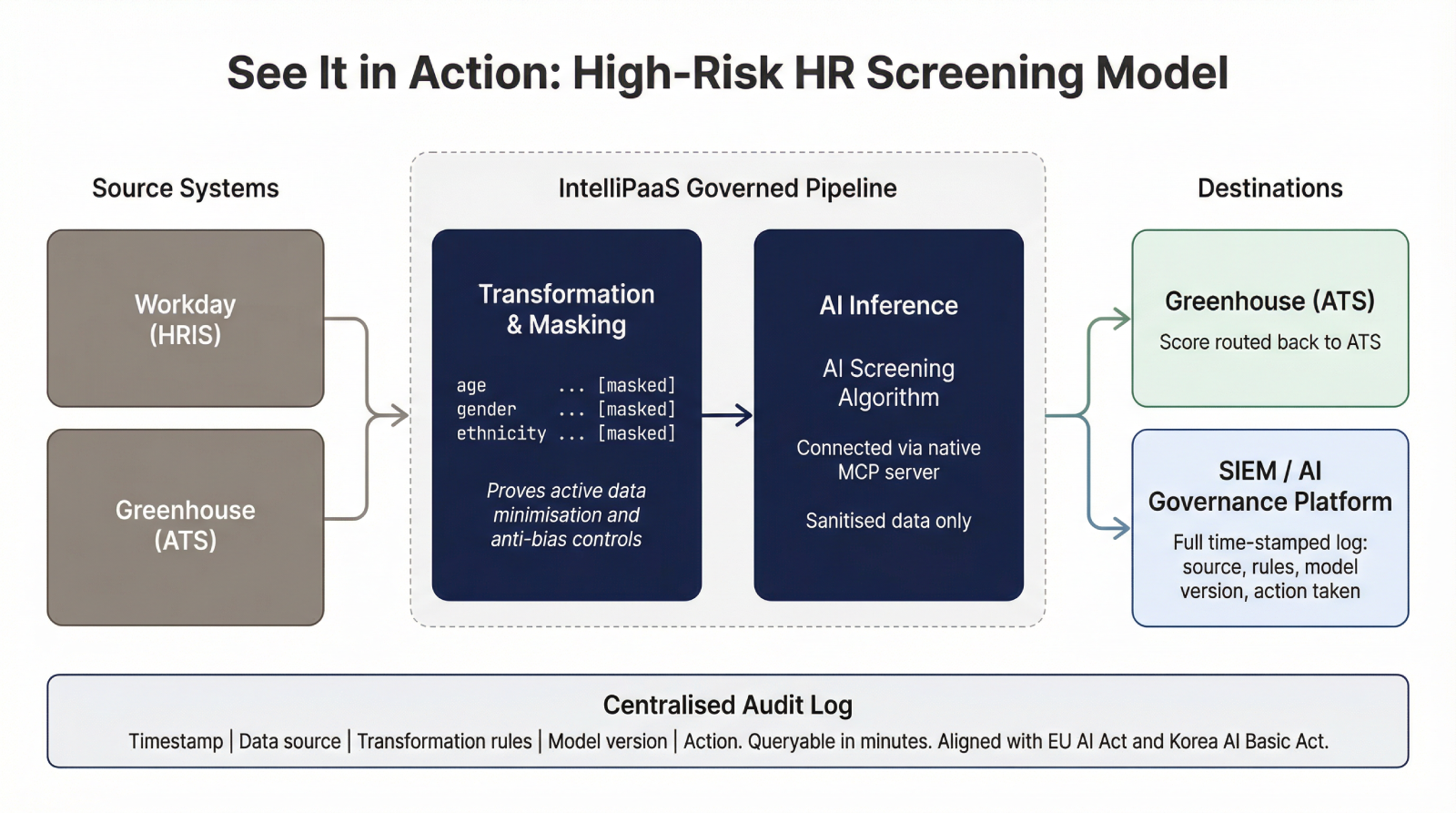
See It In Action: Compliant AI Integration, Visually Mapped
Visual Flow Example: High-Risk HR Screening Model
Source Node
Workday (HRIS) and Greenhouse (ATS) are dragged onto the canvas as data sources.
Transformation Node
A visual rule block is inserted to mask age, gender and ethnicity. This proves active data minimisation and anti-bias controls.
AI Inference Node
The sanitised data is routed into the AI Screening Algorithm via our native MCP server.
Logging & Output
The model's score is routed back to the ATS, while a complete, time-stamped log of the entire transaction is automatically streamed to your SIEM and AI Governance platform.
Regulations
Go Deeper: Explore by Regulation
Deep-Dive Guides for Key AI Laws
From this overview, you can drill into dedicated guides for each major AI law, where we unpack detailed obligations and show exactly how IntelliPaaS helps you comply at the data and integration layer.
EU Artificial Intelligence Act
Data governance, logging and conformity assessments

South Korea's AI Basic Act (Act on the Development of Artificial Intelligence and the Establishment of a Foundation for Trust)
High-impact AI safety and data duties
Brazil AI Bill No. 2,338/2023
Risk-based obligations for providers and users

Colorado AI Act (SB 24-205)
Impact assessments and anti-discrimination controls
The diagram below shows how IntelliPaaS sits between your source systems and AI workloads, enforcing policy at every step - from schema validation and PII detection through to sanitisation, routing and centralised logging.
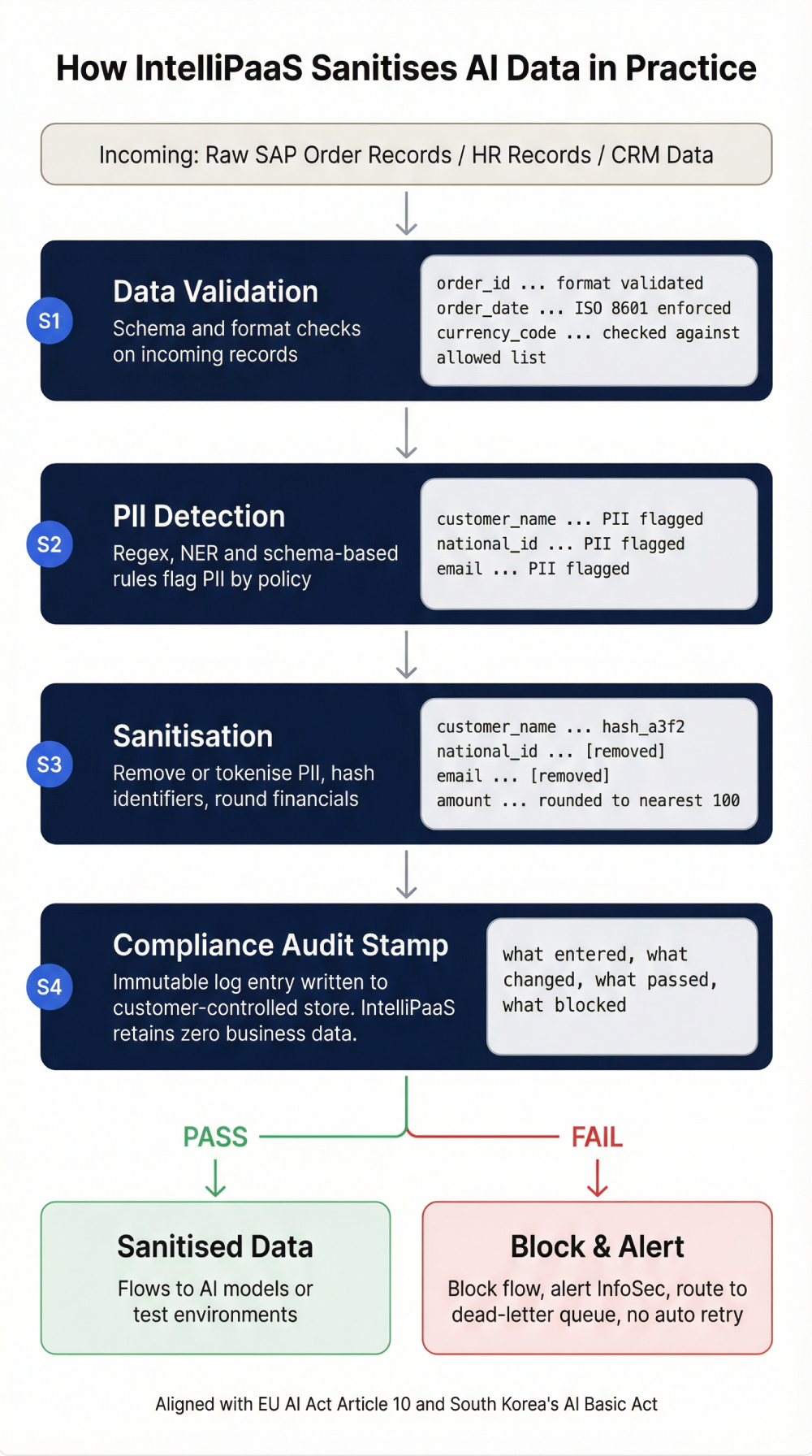
Step 1 - Data Validation
Schema and format checks on incoming records (for example SAP order records) before they enter AI workflows.
Step 2 - PII Detection
Regex, NER and schema-based rules to flag PII (national ID, names, contact details) and other sensitive attributes by policy.
Step 3 - Sanitisation
Remove or tokenise PII fields, hash identifiers, round or bucket financial amounts, enforce regional data-minimisation rules.
Step 4 - Compliance Audit Stamp
Write an immutable 'compliance stamp' log entry specifying what entered, what was changed, what was passed on and what was blocked, into a customer-controlled store (IntelliPaaS retains no business data).
Pass/Fail Branches
Pass: Sanitised data flows into AI models or test environments.
Fail: Block and alert InfoSec/compliance, route to dead-letter queue, no automatic retry.
Fail: Block and alert InfoSec/compliance, route to dead-letter queue, no automatic retry.
This process is aligned with EU AI Act data governance requirements (Article 10) and South Korea's AI Basic Act risk-management duties, ensuring your AI workflows only consume governed, traceable and sanitised data.

Audit
Get Your AI Data Foundation Audit-Ready
Don't wait for a regulatory inquiry to realise your data pipelines are a black box. Let’s map your highest-risk AI flow today.
In a 60-minute Compliance Blueprint Session, we will:
In a 60-minute Compliance Blueprint Session, we will:

Pick one high-risk AI use case currently operating in your business (e.g., hiring, credit scoring, customer profiling).
Map the current-state data flows feeding that use case.
Identify your specific gaps in lineage, logging and governance relative to EU, US, or Korean AI laws.
Show you exactly where IntelliPaaS fits into your architecture to automate compliance.
You will leave with a clear, one-page AI Data Compliance Blueprint to share with your board and risk committee.
.svg)


